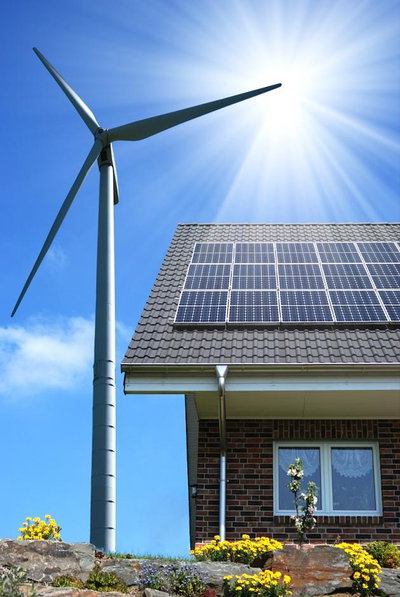














Green’ technologies and sustainable homes are crucial elements in the fight to reduce CO2 emissions to atmosphere and save energy. Such technologies can also save money – lots of it – and provide real business opportunities for electrical contractors and installers.

One definition of sustainability is ‘a sustainable future is one in which a healthy environment, economic prosperity and social justice are pursued simultaneously to ensure the wellbeing and quality of life of present and future generations. Education is crucial to attaining that future’.
In Voltimum terms, sustainability technology means sustainable equipment and products that can be fitted and commissioned by electrical contractors and installers into existing buildings or into modern sustainable buildings and related environs.
So, in terms of true sustainable technologies, we mean solar PV, solar thermal, heat pumps, microCHP, wind turbines and fuel cell systems.
In this article, therefore, we don’t include in any detail, technologies that are not ‘sustainable’ in the true sense of the definitions, but which can be used to save large amounts of energy and reduce CO2 emission. Such very important ‘low carbon’ technologies include whole house ventilation systems, fans having advanced energy saving motors, low energy lighting (e.g. LEDs, CFLs and others with modern controlgear and presence detection) and advanced electric heating systems that provide heat efficiently only when and where it is needed.
Smart home technologies are also becoming increasingly important. Aside from providing added comfort and convenience, smart home systems can also provide highly significant energy savings. And then there’s the fast expanding universe of the Internet of Things (IoT)…of that, more later.
Finally, the crucial importance of excellent thermal insulation should not be forgotten.
There’s a message to get across…
Such technologies can provide large costs savings to home and building owners, as well as helping to reduce those all-important carbon emissions into the atmosphere, and it is here that electrical contractors and installers can benefit. Looking at the crucial issue of man-made climate change, it has become clear that the best way to get the message across to many people is not to bang on about how they are contributing to global warming, rather, how they can save money by reducing their energy consumption.
This approach is now starting to work and ever more savvy electrical contractors and installers can see that they need to get the message across, often finding new business opportunities in the process. For example, they can advise their customers on how to reduce their energy consumption, which can add value to a contract.
Looking at non-residential buildings, the energy consumed for heating and cooling is typically more than half the total energy consumption of the building. The introduction of simple design concepts and currently available technologies, however, can lead to significant reductions in the energy consumption, operating costs, and carbon emissions of both new and existing buildings.
The sustainable technologies
Ignoring modern lighting, ventilation and smart home systems, which although adding greatly to energy saving, are not strictly ‘sustainable’, the technologies are as follows (in no particular order):
Solar photovoltaic (solar PV) – This highly successful technology comprises solar panels to absorb and convert sunlight into electricity, a solar inverter to change the electric current from DC to AC, as well as mounting, cabling, an integrated battery and other electrical accessories to set up a working system. It may also use a solar tracking system to improve the overall performance.
Solar PV systems, for which prices have declined rapidly, range from small, rooftop-mounted or building-integrated types with capacities from a few kW to several tens of kilowatts, to large utility-scale power stations of hundreds of megawatts. Today, most solar PV systems are grid-connected, while off-grid or stand-alone systems only account for a small portion of the market. A rooftop system typically recoups the invested energy for its manufacturing and installation within a few years and produces about 95% net clean renewable energy over a 25 - 30-year service lifetime.
Solar thermal – Leaving aside massive and highly efficient utility-sized molten-salt solar thermal plant, what we refer to here is the use of the sun’s rays for hot water heating.
Sometimes known as solar water heating (SWH), this sustainable technology involves the conversion of sunlight into renewable energy for water heating using a solar thermal collector.
In a close-coupled SWH system, the storage tank is horizontally mounted immediately above the solar collectors on the roof. No pumping is required as the hot water naturally rises into the tank by thermo-siphon flow.
In a pump-circulated system, the storage tank is ground- or floor-mounted and is below the level of the collectors, so a circulating pump is used to move water or heat transfer fluid between the tank and the collectors.
SWH systems will provide warm or hot water for most of the year, but in winter there may not always be enough solar heat gain to deliver sufficient hot water. At such times, a gas or electric booster is used to heat the water.
Heat pump – This uses an electric motor to drive a refrigeration cycle, drawing energy from a source (usually the ground or external ambient air), and pumps it into the space to be heated. Note that this is an essentially reversible process, so heat pumps can also be used to cool spaces.
Although heat pumps will not be suitable for every application, they are very energy efficient and are often labeled ‘sustainable’, though some say that this technology is strictly ‘low carbon’ – it depends on the coefficient of performance (COP). The higher the COP, the more ‘sustainable’ the heat pump is.
MicroCHP – This is a small (roughly domestic boiler sized) combined heat and power unit that generates both heat and electricity from the same energy source. The main output of a microCHP system is heat, with some electricity generation, typically at a ratio of about 6:1 for domestic appliances.
A typical domestic system will generate up to 1kW of electricity (or slightly more), but the amount of electricity generated over a year depends on how long the system is able to run. Any electricity generated that isn’t used can be sold back to the grid.
Normally mains gas (or LPG) is burned to power a small and very quiet Stirling (hot air) engine that drives a small AC generator to provide the electrical power. The waste heat is fed back into the gas boiler. This makes for a highly fuel-efficient system that can be wall-hung or floor standing. Both small internal combustion engines and fuel cells can also be used to generate the electricity. Installation is simple and the Feed-in-Tariff (FIT) applies, as it does to solar PV.
There has been much excitement about microCHP, but development is still needed and costs are relatively high – and as modern conventional boilers are now so efficient, this technology has been relatively little used so far. The larger miniCHP systems, however, have been much more widely used in blocks of flats, and as part of district heating schemes - especially in mainland Europe.
Wind turbines – This technology comprises a tower, with a two- or three-bladed turbine at the top driving a generator through up-speed gearing. A transformer converts the generated electricity into a form that can be used. The turbine blades turn to face the wind automatically.
Very large wind turbines are a proven technology increasingly used worldwide to provide ever-larger proportions of sustainable electrical power to grids, but smaller turbines – especially those intended for domestic homes – are more problematic. The airflow to such turbines absolutely must not be interfered with by nearby buildings, other structures or trees. Furthermore, if roof-mounted, damage to roofs can occur in storms etc.
Just as with solar PV, any excess electrical energy generated can be sold to the grid, but a problem with both wind turbines and solar PV is that they only generate optimally (or at all) when the conditions are right (lots of wind and sun). However, suitable energy storage units - such as special batteries and other technologies - are being developed to overcome this difficultly.
Fuel cell - This converts a fuel’s chemical energy into electricity through a chemical reaction of positively charged hydrogen ions with oxygen or another oxidising agent. Fuel cells are often likened to batteries but are different in that they require a continuous source of fuel and oxygen or air to sustain the chemical reaction, whereas in a battery the chemicals present in the battery react with each other to generate electricity. Fuel cells can produce electricity continuously for as long as these inputs are supplied.
There are many types, but all comprise anode, cathode, and electrolyte that allow positively charged hydrogen ions (or protons) to move between the two sides of the fuel cell.
As by-products, fuel cells produce water, heat and only very small amounts of nitrogen oxides and other emissions. So they are very clean, and the efficiency is also high, at around 40 – 60% (up to 85% efficient if waste heat is captured for use).
The fuel cell market is growing, and Pike Research (via Wikipedia) has estimated that the stationary fuel cell market will reach 50GW by 2020. A big advantage is the technology’s use of hydrogen, which will never run out, but other advantages include cleanliness, high power output and they need little maintenance.
However, the disadvantages are that to separate the atoms of the hydrogen and oxygen and generate hydrogen fuel, fossil fuels are needed. This defeats the purpose of an alternative energy source. Also, while fuel cells are non-toxic, there is a flammability (and even explosion) risk, and they are also expensive to make.
The effect of the ‘Internet of Things’
This article is not covering other modern energy and emissions saving technologies like the latest lighting, ventilation, heating and smart home systems, because as already stated – although very important – they are not strictly ‘sustainable’. But there is one technology, with while again is not sustainable in itself, is becoming so fast growing and important that it must receive mention here. That is the Internet of Things (IoT).
Imagine a world where your heating turns on or off according to your calendar schedule – or in other ways. Your lighting too….Now you can do this with the help of the IoT as part of the energy saving smart home or automated building.
The IoT is the network of physical objects or ‘things’ embedded with electronics, software, sensors and connectivity to enable it to achieve greater value and service by exchanging data with the manufacturer, operator and/or other connected devices. Each ‘thing’ – which might be a room thermostat for example - is uniquely identifiable through its embedded computing system but is able to interoperate within the existing Internet infrastructure.
The IoT is already providing advanced connectivity of devices, systems, and services that go beyond machine-to-machine (M2M) connectivity, and it covers a variety of protocols, domains, and applications.
The interconnection of these embedded devices, will lead to automation in nearly all fields, including of course, heating, ventilation, smart meters - and all things sustainable as well. Suffice to say for now, that the IoT has the potential to make even larger energy savings in homes and other buildings, so it is essential to start learning about it now.
See more from Voltimum on Google
Add Voltimum as a preferred source and Google will show our articles more often in your news results.