Published: 4 March 2015
Category: Manufacturer News
OSRAM and the Transfer Centre for Neuroscience and Learning carried out a common study at schools in Ulm, Germany in 2011 investigating whether and how biologically optimised classroom lighting is able to contribute to stabilising the circadian rhythm and thus also support alertness in the mornings.

The issue: Is daylight-similar light able to contribute to pupils being more alert and concentrated in the mornings and gain better results with cognitive tests?
Study summary about school lighting
1. Biologically optimised lighting
Certain lighting characteristics determine whether our biological system is stimulated effectively. These include colour temperature, planarity and light direction as well as dynamic light according to times of the day.
Colour temperature
Our "biological" photo-receptors respond particularly strongly to blue light, and the range of maximum sensitivity approximates a wavelength of 460 nanometres. This means that the ganglion cells of the retina are especially excited by light sources with high blue components, meaning light sources with a high colour temperature. Cool white light sources with a colour temperature from 6,500 Kelvin upwards, or even better, 8,000 Kelvin or higher, are suitable. Fundamentally, warm white light sources such as halogen lamps can also be used. To achieve comparable effects though, significantly higher lighting intensities are needed than with a cool white light source, meaning higher energy requirements and possible glare effects.
Planarity and light direction
Photo-receptors are distributed uniformly over the retina in the eye. If as many receptors as possible are stimulated simultaneously, this has the greatest effect, and this is achieved with planar lighting. Because the most sensitive receptors are located in the lower area of the retina, light entering from above excites these receptors best. In nature this corresponds to the sky. The same effect in rooms can be achieved with planar light sources or illuminated surfaces such as bright walls and ceilings. In such cases the surfaces should be able to reflect the blue light components well.
Dynamic light according to the time of day
In nature, lighting intensity and the colour temperature of daylight is characterised by a continuous and dynamic sequence. These dynamics according to the time of day must also be integrated into biologically effective room lighting in order to sensibly support both active and calming phases of the human organism. In practice, light management systems are used that enable colour temperature sequences according to needs, and in ideal cases the separate control of direct and indirect lighting.
2. Realisation of biologically optimised lighting in the survey
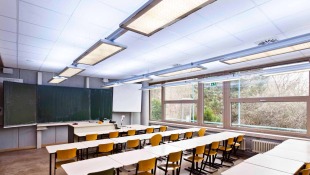
Suspended LED luminaires were used for classroom lighting in the survey. The colour temperature for direct lighting was 4,000 Kelvin. In order to also fulfil the above-specified requirements for biologically effective lighting, an LED module for illuminating the room ceiling (indirect lighting) was developed specifically for the survey and integrated into the luminaire system. In this way the combination of blue and cold white LEDs achieved a very high colour temperature of up to 14,000 Kelvin in the classrooms, similar to the colour temperature of daylight. The light control used also enabled the dynamic adaptation of lighting intensity and colour temperatures in compliance with the rhythm of the pupils' inner clock at any time of the day.
3. Implementation of the light survey at schools
Time period
The winter season was specified for the survey period because these months have insufficient light in the morning hours that enables us to normally be fit and alert. As a result the tests were carried out in November and December of 2011.
Control group comparison
A technical high school and a vocational high school each with two school classes participated in the survey (a total of 68 pupils of ages 17 to 20). The new and biologically optimised lighting concept was installed at each school in one classroom (intervention room), and in each case an adjacent room served as a comparison room. Here the lighting remained unchanged: Louver luminaires with T8 and T5 fluorescent lamps with a colour temperature of 3,000 or 4,000 Kelvin ("standard lighting") were used. The influence of light entering from outside was identical in the intervention room and comparison room due to the same alignment, room size and furniture. Brightness and lighting were also identical. The biologically optimised lighting was set so that it's lighting intensity corresponded to the standard lighting: 700 lux horizontal lighting intensity on desk surfaces, and 300 lux vertical lighting intensity measured at eye height towards the blackboard. Both the intervention group and comparison group had similar structures with regard to age and educational standards.
Standardised psychological tests
To measure the influence of biologically optimised lighting, standardised psychological tests were used. The level of attention of the pupils (concentration on the set task) was recorded using the so-called d2 test according to Brickenkamp. The task consists of having a sheet of paper with several rows of letters and dashes, and crossing out as many 'd's' as possible marked with two dashes in each row within 20 seconds, without any misses or mistakes. The concentration performance value is recorded (hits minus mistakes) as well as the error percentage value. Cognitive performance speed, specifying how quickly a task is solved, is also measured using a number connecting test. Here survey participants have to bring randomly arranged numbers into their numeric sequences. Retentivity is tested using a visual and verbal multi-capability task whereby test persons are given a short period of time to memorise information and then express this. In the first part the information consists of a visual-spatial map, and in the second part of the test terms, names and numbers occurring in a text.
Survey structure
The structure of the survey as described below was identical for both schools. The intervention group and comparison group were tested on two dates with a gap of five weeks in between (pre/post measurement). The first (pre-) recording was carried out with all participants below normal standard lighting. The new biologically optimised light was installed in the intervention room directly following the first recording. The intervention group was then subsequently taught in the mornings in at least both first lessons with biologically optimised lighting. After six weeks below the new lighting, the influence of the circadian rhythm can theoretically be determined: It is expected that pupils spending time in the mornings below the new lighting are more attentive and also benefit from improved concentration. To put this hypothesis to the test, both groups were then tested again below standard lighting (post). The same standardised tests (d2 etc.) were again used.
The effect of a short-term "light shower"
A further test was carried out to see whether a short "shower of light" led to improvements in cognitive performance capability: With a section of the pupils only taught below standard lighting, the concluding test (post) was carried out with biologically optimised lighting.
4. Survey results
The survey showed overall positive results with pupils taught in the classroom with biologically effective lighting. The increase in attention capability, cognitive performance speed and retentivity for the intervention group and comparison group were directly compared. In the d2 test the intervention group showed significantly better results than their fellow pupils in the comparison classes. The increase in cognitive performance speed was also distinctly greater, and a similar tendency was also observed with the retentivity tests. It was also shown that biologically optimised lighting has short-term effects.
Improvements due to the light shower were however not as pronounced as the longer-term effects that led to stabilisation of the circadian system from light. Sleeping behaviour could also be documented using sleep diaries written by several pupils. The intervention group pupils slept in total just as much as the pupils from the comparison group, but their sleeping rhythm was extended to a certain extent: They went to bed earlier in the evening because they felt fitter in the mornings.
Summary
Attention and the cognitive performance capability of pupils can be increased with the aid of biologically optimised lighting. With the new lighting designed to simulate daylight, participating pupils achieved better results in standardised tests for concentration capability than the comparison group. Performance speed also increased significantly. It is seen that new lighting concepts oriented to nature and achieving daylight-similar properties for indoor rooms have positive effects on the biological organism.