













The LED revolution has ensured that the past ten years or so has been an incredibly exciting one for the global lighting industry. This vast change is still gathering place as ever more conventional lighting systems are being superseded by LED systems. And now the Internet of Things promises another revolution.

Why is this LED revolution taking place? It’s for many reasons. One is that - bearing in mind lighting accounts for around 19% of global electricity production (according to the International Energy Agency), and that two thirds of the current lighting is based on older, energy-inefficient technologies developed before 1970, a full switch to the latest LED lighting solutions would provide massive energy savings. These, it has been estimated, would average 40%, with a corresponding big reduction in CO2 emissions.
The major lighting companies that do most of the LED research – such as OSRAM, Philips and Megaman – have seen very substantial growth in LED modules, lamps, light engines and drivers over recent years, despite an often challenging financial environment, while financial analysts believe that the global LED lighting penetration rate will (possibly very conservatively) reach 70% by 2020.
A downside for the serious lighting manufacturers is that LEDs are now becoming virtually commodity items, with many suspiciously low-cost items on sale from across the world. While high quality LED lighting costs far more to make than the now-banned incandescent lamps, the demand is always for ever lower prices. This is causing problems for a number of bona fide manufacturers.
The latest trends
Currently, the main R&D drivers of LED lighting development have not changed much since our. They include maximising the energy efficiency of these products in the market place, removing market barriers through improvements to lifetimes, light output, colour quality and lighting system performance, and reducing the purchase costs of LED light sources and luminaires. Then there is the rapid growth of LED street lighting systems.
Another important task – with a number of advanced and reputable manufacturers taking key roles – is to improve product consistency while maintaining high quality products. ‘Binning’ is one aspect of this and is crucially important. As Philips Lighting has noted: ‘During production, LEDs will vary in colour, flux and forward voltage and this is also true for products from the same batch. The differences are significant and therefore LEDs are measured and delivered to the market in subclasses or groups called bins and this process of segregating LEDs is called binning.
‘So a particular bin may contain LEDs, which emit light within a range of wavelength, range of flux values and also the range of forward voltage that can be applied safely to the LEDs. For instance a bin might only contain LEDs having Max - Min dominant wavelength in the range of 587 - 584.5 nm (i.e. a range of 2.5 nm, thereby guaranteeing colour consistency) and LEDs emitting flux in the range of 6.3 - 8.2 lm (thereby ensuring that LEDs in the bin have similar brightness) and the same LEDs must have their forward voltage in the range of 2.31 - 2.55 volts (thereby ensuring that when LEDs from the same bin are electrically connected the applied voltage will not destroy any LEDs)’.
Binning is essential for the ultimate success of most LED applications, so a lot of work is going into improving consistency – and this is happening.
OLEDs – any progress?
Organic light emitting diode (OLED) technology is still very much in the development phase, and progress is indeed being made. Even so, it is now generally recognised that even longer term, OLEDs are likely to find only niche applications, such as for small screen devices (smartphones, tablets, computers and some instruments), but future applications will also likely include car dashboard displays, ‘billboard’ displays, and certain types of flexible lighting systems for homes, retail and offices.
OLEDs are currently thought unlikely to compete with LEDs (or traditional types) for most general lighting applications.
Intelligent control
Other important drivers in the LED lighting marketplace include the expansion of the technology into the so-called ‘smart cities’ and intelligent lighting control.
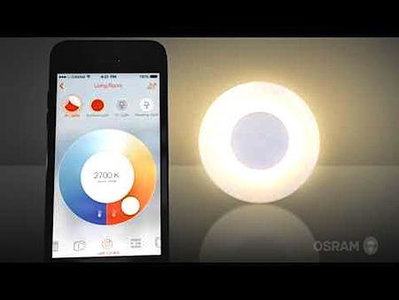
As an example, there’s OSRAM’s LIGHTIFY, which users can control their complete lighting system at home or in the garden just with one app via smartphone or tablet PC. Every LIGHTIFY lighting product can be controlled via a Wi-Fi router and the LIGHTIFY gateway.
Philips is also in on the act with its Internet connected and smartphone controlled Hue, which allows homeowners to obtain full control over the light in their lives by setting the mood and changing the ambience using varying light output and colour. With tunable white light and a full spectrum of colour, all at the tap of a smartphone or tablet app, homeowners can set the perfect tone and enhance any moment – almost instantly.
There is also the wireless LightwaveRF system. LightwaveRF is a range of intelligent dimmers and other devices and sensors that are just that little bit smarter. While they look and work just like ordinary dimmer etc, they will change the way homeowners and their families control their lighting, heating and power in their homes. Because of this 'intelligence' and the ways in which such lighting and related devices can save energy and money, they are at the same time becoming part of the smart home revolution.
Lighting becomes part of the Internet of Things
Then there’s the ‘Internet of Things’ (IoT), which we’ve been starting to cover extensively in Voltimum this past year.
The fast expanding IoT is the buzzword of the moment and there’s no denying the excitement it is causing. With the IoT, just about everything can be IP- or otherwise wirelessly-connected, is being so or can be so. For example, your lighting can ‘talk’ with other devices and systems and to your smart phones and tablets.
This is happening already, with for example, Philips’ Hue LED lighting system, which is now ‘in bed with’ and talking to Google’s Nest smart thermostat and security devices, plus a fast growing range of varying ‘intelligent’ devices from other manufacturers.
So wireless networking technologies are bringing intelligence to a new generation of smart lighting. It is partly for this reason that key industry figures predict that IT companies may take a significant share of the wireless lighting controls market in the future – possibly as part of the IoT. LED based lighting devices combined with wireless technologies are changing the market and finding good opportunities – and are also increasing the business opportunities for switched on electrical contractors and installers.
Yet some in the lighting industry believe that the future is no longer merely in manufacturing LEDs to provide light; because of the almost limitless possibilities offered by intelligent lighting control and the IoT – together with LEDs, which are of course digital devices – the future instead will be much more environmental and all-encompassing.
Examples include circadian lighting , which – for example – can control the amount of blue light throughout the day, from a stimulating ‘biological light’ to a restful ‘biological darkness’, or permanent digital ‘skylights’ that change in color and intensity as the day progresses. Others include LEDs to improve your health in other ways, such as better sleep. And LED lighting now also has a fast-growing market in the healthcare sector for similar reasons.
LEDs also have the potential to ease pain, revolutionise agriculture, reduce traffic accidents and improve urban safety. After all, the clever use of lighting (and not just LED) to boost retail sales has been used in retail outlets and supermarkets for years.
This sort of thing is important for electrical contractors and installers too, because when an LED lasts 15 to 20 years or more, who is going to change them often? It will be more important to be able to work with LED lighting’s connections to the Internet of Things.
Please let us know your thoughts in the comment section below.
See more from Voltimum on Google
Add Voltimum as a preferred source and Google will show our articles more often in your news results.